Why Business Sales Fall Apart: What Kills a Deal After the Price Is Agreed
Quick Answer
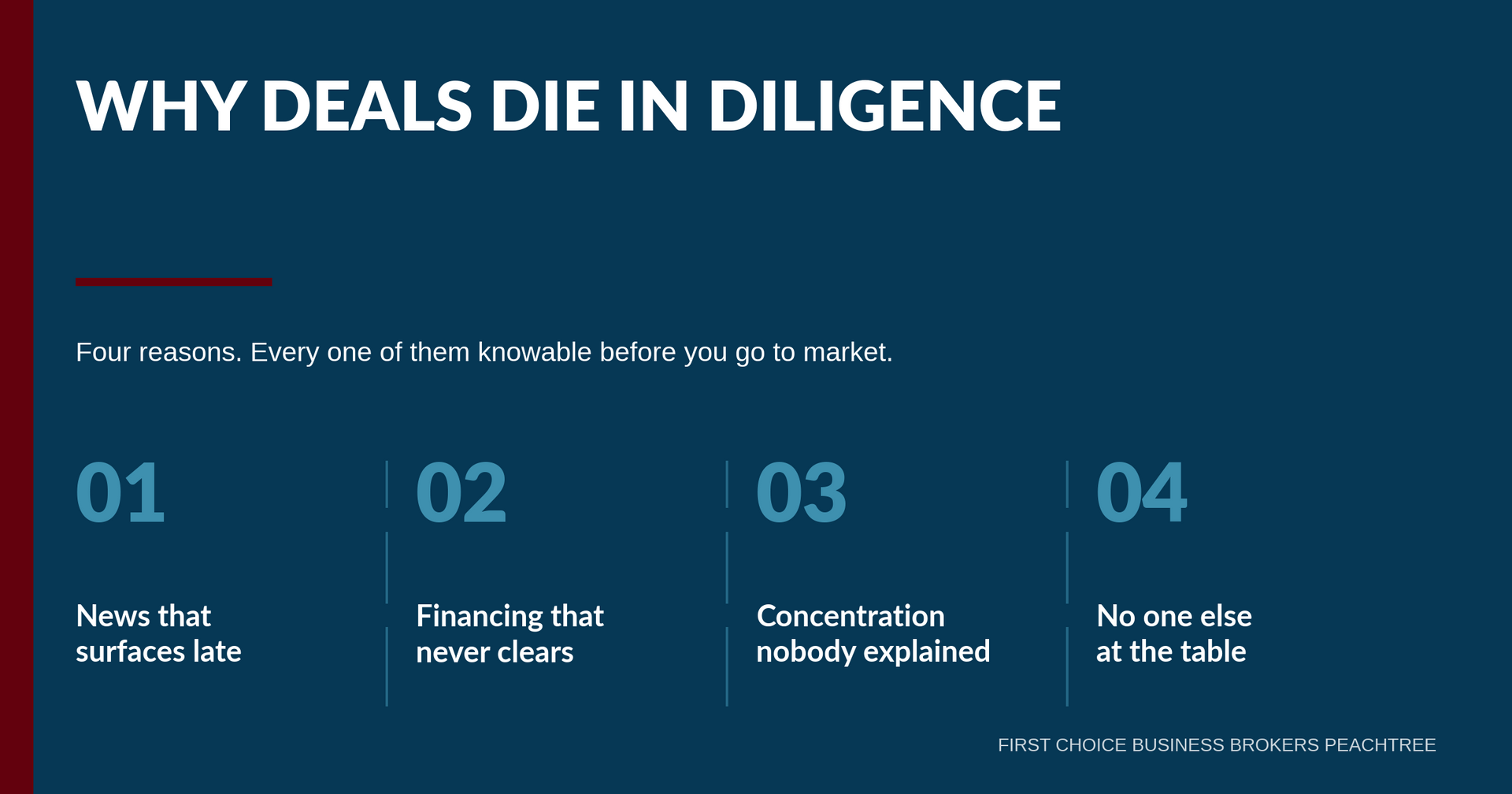
Deals that have already been priced, structured, and agreed most often fail during final confirmatory due diligence, over four things: news that surfaces late, financing that does not clear underwriting, customer concentration whose real nature was never fully disclosed, and minor findings used as leverage when no other buyer is in the picture. All four are knowable before going to market, which is where the work to prevent them belongs.
Most owners assume a business sale is won or lost in the negotiation. Getting to an agreed price is hard work. It is not where most sales come apart.
Sales fail in two very different places. Many never attract a serious buyer, which is a different problem with different causes. This is about the other kind: the deal that gets priced, structured, and agreed, and then dies in confirmatory diligence. Sellers overlook it because by then the hard part feels finished. None of it is bad luck.
When should you disclose bad news to a buyer?
Bad news costs you a buyer. Late news costs you the deal.
A problem disclosed early can be priced. A buyer who walks at that point was never buying the business you actually have. The same problem surfacing after a price is agreed reads like something the seller hid, and trust takes the deal down with it. The issue itself is often manageable. The timing is not.
This is the practical case for developing a positioning story that withstands buyer scrutiny before the process starts. The story you tell at launch has to be the story you are still telling through diligence and at closing. When it changes, the buyer stops trusting the version they underwrote, and every remaining question gets asked with more suspicion.
A Quality of Earnings analysis done before going to market tests that story before a buyer does. It gives an owner the what and the why behind the numbers, so nothing in them is new when the buyer's accountants arrive.
One thing sits entirely inside the seller's control: who tells the buyer first.
What happens when the buyer's financing falls through?
A deal can be fully agreed and still fail in the lender's underwriting.
The buyer and the seller settle on price and terms, subject to a financing contingency. Then the buyer's lender runs its own analysis. If the business does not clear it, the agreed deal does not get funded on the terms that were signed.
Underwriting stalls over a predictable set of things: thin debt service coverage, customer concentration the lender will not accept, financials that do not hold up under a closer look, or a buyer whose own finances fall short of the lender's bar.
A shortfall does not always end a deal. More often it reshapes one: a larger seller note, more equity from the buyer, or a lower price. The deal survives, and the seller pays for it.
Sellers control more of this than they expect. Before going to market, a lender can pre-qualify the business, supported by a Quality of Earnings analysis that validates the numbers underwriting will test. Testing the financing early turns a late renegotiation into an earlier, informed negotiation about structure.
When does customer concentration break a deal in diligence?
Not every business carries this exposure. A company selling to thousands of consumers, or to a broad base of small commercial accounts, may have no meaningful concentration at all. Where a few customers carry the revenue, it is among the first things a buyer and a lender test.
Where it applies, the percentage is not what breaks the deal. A prepared seller volunteers a customer schedule and an unprepared one gets asked for it, so no serious buyer prices a business without it. What surfaces in confirmatory diligence is the texture underneath the number: who owns the relationship, how the customer actually buys, and how firm the commitment really is.
That is where deals break. Reference calls reveal that a top relationship runs through the owner personally rather than through the company. What was described as a contract turns out to be a run of purchase orders. A major agreement sits inside its renewal window, which the seller knew about and the buyer will not underwrite around.
Buyers look through two lenses: the largest single customer, and the top customers as a group. Across the deals I have worked, similar thresholds hold up. A single customer under 10 percent draws little attention. Between 10 and 20 percent, the questions start. Between 20 and 30 percent, expect reference calls and pressure on value. Above 30 percent, a real share of buyers walk. The group lens catches what a single number misses: once the top few customers approach half of revenue, buyers stop seeing a durable enterprise and start seeing a set of relationships.
The way through is disclosure, early and protected. Names do not have to be revealed to describe the risk honestly: an anonymized schedule or chart can show each major account's share, contract status, tenure, and who holds the relationship. A buyer and a lender who can evaluate that before a price is set will structure the deal around it. The ones who learn it afterward renegotiate instead.
Timing and contract terms decide how much the concentration actually matters. I represented a logistics company whose customers manufactured consumer durable goods. One customer was more than 25 percent of revenue, and that contract sat inside a year of renewal. A strategic buyer in the same industry was interested early, and was clear on one point: no offer could come until the contract was re-awarded for a new term. We had advised the owner the same before he ever spoke to a buyer. Wait for the re-award, then go to market. He agreed. Once the contract was re-awarded, that buyer paid a full multiple, because the renewed term had removed the risk that held things up.
The concentration did not lower the price. It set the timing. And it turned on a detail most owners overlook: a customer worth 25 percent under a multi-year contract is a different risk than the same customer buying on short-term purchase orders. Structure can matter as much as size.
Why do minor due diligence findings get absorbed in one deal and repriced in another?
Confirmatory diligence always produces findings. A significant finding moves the deal regardless of who else the buyer believes is at the table. That is underwriting, not leverage. What competition changes is what happens to the small ones.
A buyer who believes no one else is in the picture can treat a few minor findings as an opening to renegotiate. A buyer who believes the seller has alternatives tends to absorb the same findings rather than risk the deal over them. Same facts, two outcomes, decided by something that has nothing to do with the findings themselves.
No buyer knows what other conversations are happening. A buyer infers. A seller negotiating alone, with no advisor and no process, invites one inference. A seller in a properly run process invites another. Neither requires telling the buyer who else is looking. This is the quiet cost of the unsolicited offer.
What do all four failures have in common?
Every one was visible before a buyer appeared. Three are conditions inside the business: what the numbers say, whether the earnings support the financing, and what sits underneath the revenue. The fourth is a decision rather than a condition: how the business goes to market, and whether the buyer believes anyone else is at the table when the findings arrive.
None of that is negotiation. All of it is preparation, and preparation is the part an owner fully controls.
How do you prepare a business for sale?
Five things, in the order they pay off.
1. Commission a sell-side Quality of Earnings analysis. It establishes the earnings the price is built on, and surfaces what a buyer's accountants would find first.
2. Have the business pre-qualified for financing. It removes the one failure mode no amount of negotiation can fix.
3. Disclose the concentration and its nature, early and under confidentiality. Both lenses, largest single customer and the top group. Then go past percentages to who holds each relationship, whether revenue sits under contract or purchase orders, and when those contracts renew. Anonymized, that picture can reach a buyer before a price is set.
4. Assess how much the business depends on you. The concentration problem above is often an owner-dependence problem underneath: the relationships, the sales origination, and the judgment run through you rather than the company. Whether the people, processes, and systems run without you is the slowest of the five to fix, which is why it should start first.
5. Create real alternatives. A confidential process, run properly and to more than one qualified buyer, is what creates them. Enough credible interest that the terms agreed at the start are the terms that close.
None of this is a solo exercise. A good M&A advisor or business broker works through this list with you and tells you which findings a buyer will care about and which they will not. Willingness to say the business is not ready yet is part of the job.
None of this removes confirmatory diligence. It decides what diligence confirms, and who found it first.
A deal dies over what surfaces late. What surfaces late was knowable early.
Everything above happens after a price is agreed, and the price itself comes from
how a buyer values the business.
Torey S. Hinkson is President and Owner of First Choice Business Brokers Peachtree, advising business owners across Georgia and the greater Atlanta area. He spent twenty years as an investment banker executing mergers and acquisitions across many industries, representing billions of dollars in transaction value, and now applies that experience to the lower middle market. He served as a Marine Corps infantry officer, holds an MBA from the University of Maryland, and earned a Bachelor of Science from the United States Naval Academy.
Honest valuation. Disciplined process. Confidential execution.