How Does a Buyer Determine the Value of Your Business?
Quick Answer
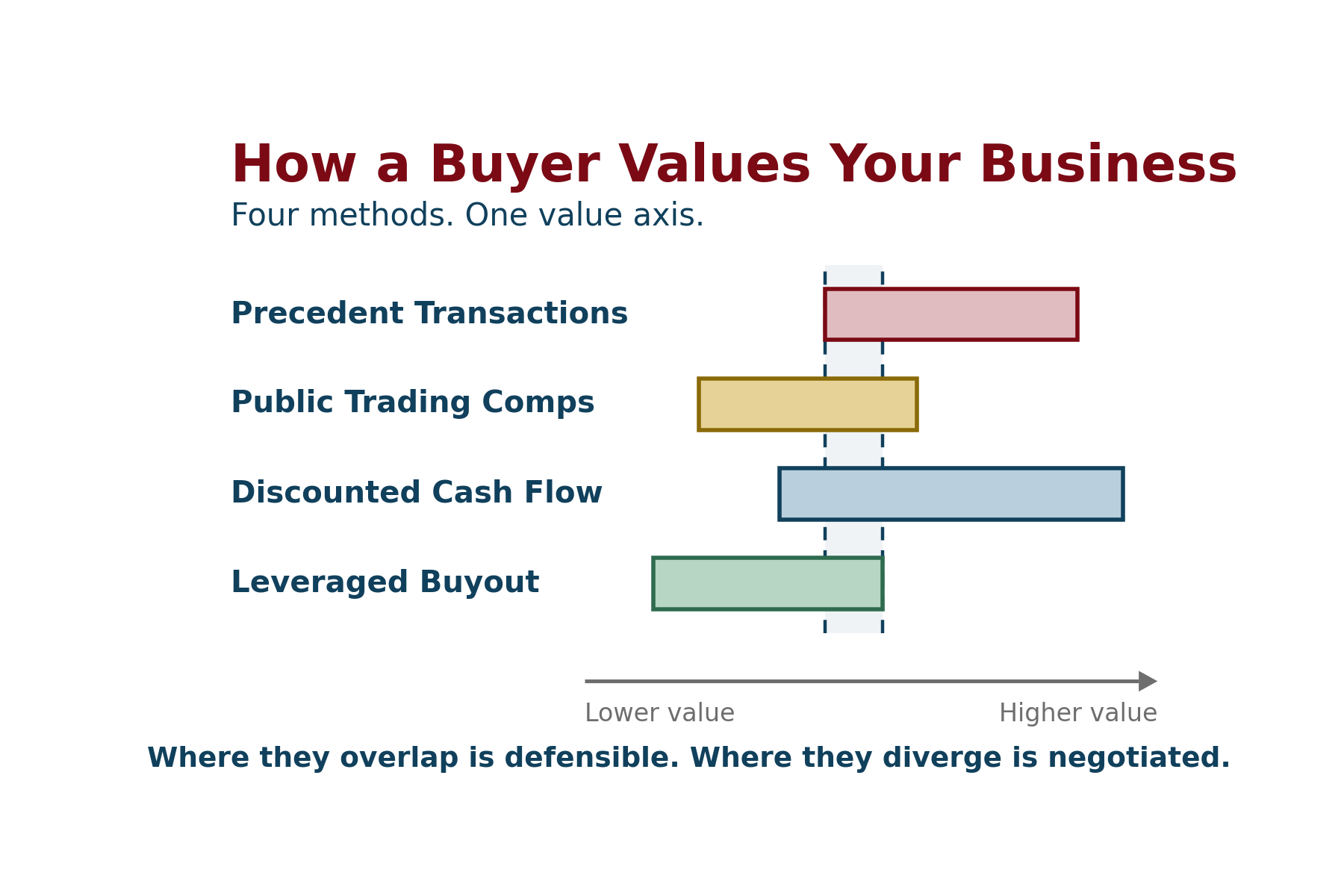
A business is worth what a willing buyer and a willing seller agree on. That is the honest answer and by itself it is not a useful one, because it does not tell you how a buyer arrives at their number. Buyers work from three lenses: what similar businesses have sold for (Market / Comparable Approach), what the future cash flows are worth today (Income Approach), and what that particular buyer can afford to pay (Ability to Pay). Each produces a range rather than a single figure. Those ranges usually overlap, but they rarely match. The overlap is where a deal is defensible. The divergence is what gets negotiated. Which lens carries the most weight depends largely on the size of the business and on who the buyer is.
What is fair market value for a business?
Almost every owner comes to the question with a figure already in mind. It came from a friend who sold three years ago, a multiple mentioned at an industry event, or a sense of what two decades of work ought to be worth.
The standard definition of fair market value is the price agreed between a willing buyer and a willing seller, neither under compulsion and both reasonably informed. Everyone quotes the first half. The second half is where the money is.
Neither condition is guaranteed. Compulsion is often not a choice: health, a partner dispute, a divorce, or financial pressure can put a seller on a clock nobody chose. A process cannot remove that. What it can do is offset it. Competition maximizes your negotiating leverage, which is what protects a seller working against a real constraint. And preparation creates the second condition directly, because a buyer working from incomplete records is not informed, and prices the gap accordingly.
So the useful question is not what the business is worth in the abstract. It is how a buyer arrives at a number, and what moves that number before they do.
How does a buyer arrive at a number?
A buyer does not start with a number and look for support. They start with methods, and the number is what the methods produce. Three lenses are in common use, and each answers a different question about the same business. Most serious buyers use more than one, and the ranges they produce rarely overlap completely.
What similar businesses have sold for (Market / Comparable Approach)
The buyer looks at completed transactions for businesses of similar type, size, and geography, and applies the multiple those deals produced to your normalized earnings. The inputs are prices someone actually paid.
Recency matters as much as similarity. A business like yours that sold five years ago traded in a different credit market, at different rates, to buyers with a different appetite for risk. Older transactions sometimes have to be used anyway, because too narrow a window does not produce enough data to be reliable. The judgment is in knowing what changed in between, and weighting the data accordingly.
A second version compares against public company trading multiples. That reads sector direction well and prices a single private business poorly, because public companies are far larger, more diversified, and more liquid. Both versions share one constraint: no two businesses are alike.
What the future cash flows are worth today (Income Approach)
A forecast of what the business will produce over a period of years gets discounted back to a present value, at a rate reflecting what investors require to put capital into a business like yours. In a formal analysis that rate is the weighted average cost of capital.
The projections usually originate with the seller or management, and the buyer decides what to believe. Buyers discount seller forecasts heavily, and a business with no history of budgeting against actuals gives them little to work from. What they fall back on is what they can observe about the business itself. The formal version is a discounted cash flow, usually called a DCF.
What this buyer can afford to pay (Ability to Pay)
This lens answers a different question than the other two. It does not estimate what the business is worth. It sets a ceiling on what one particular buyer can pay for it, and those are not the same thing.
A financial buyer works backward from the return they require and the debt the business can carry, then solves for the highest price that still clears both. In a leveraged buyout, or LBO, a private equity buyer runs precisely this calculation across a projected hold period.
At the smaller end of the market, the same logic appears as a lender's underwriting: whether cash flow covers the debt service with room to spare, and how much equity the buyer is required to inject alongside it. Both constraints bind, and a buyer who clears one and fails the other cannot pay that price.
Do strategic, private equity, and individual buyers value a business differently?
Yes, but not by picking and choosing among the three lenses. A serious buyer runs every approach that applies, because each one informs a view of how the market, and the competition for the asset, will price it. The difference is in the weighting, and it varies with the size of the business and with what the buyer intends to do with it.
Size changes which lens carries the most weight
In smaller businesses, comparable transaction data exists in reasonable volume and forecasts usually do not. There is no management team producing budgets, no history of budgeting against actuals, and the buyer is often an individual or a small group whose offer is capped by what a lender will underwrite.
The comparable lens sets the range and the financing test caps it. A discounted cash flow has limited use when there is nothing credible to discount.
As businesses get larger, that balance shifts. There is a management team, budgets with a track record behind them, and reviewed or audited financials in place before a buyer ever appears.
Comparable data tracks sector activity more than size. Where a roll-up is underway, transactions are plentiful and recent. Where one is not, larger businesses tend to be more distinctive and the pool thins. The income approach becomes both possible and meaningful, and sophisticated buyers run one alongside their comparable analysis rather than instead of it.
Ability to pay does not fade as businesses get larger
It changes names. The lender's coverage and injection tests become the sponsor's return model, and both answer the same question: what can this particular buyer pay and still get what they came for.
The strategic buyer is the exception, with an important caveat
A competitor, a supplier, or a company in an adjacent market is not only valuing your business standing alone. They are valuing what it becomes inside theirs: customers gained, capacity they no longer have to build, overhead that stops being duplicated. That can support a price above anything the three lenses produce for a financial buyer.
They will not hand you that value, though. The synergies are created after closing, largely by them, and a strategic buyer's opening position is to keep every dollar of it. What changes their behavior is competition. When another credible buyer is at the table, a strategic can reach into that additional value to win, and typically only then. The value exists either way. Whether any of it reaches you is a function of the process, not the arithmetic.
Which earnings number is a buyer actually pricing?
All three lenses eventually run through your earnings. The comparable lens applies a multiple to them, the income approach forecasts from them, and the ability-to-pay test asks how much debt they can carry. So the earnings figure everyone works from matters.
Not the profit on your tax return. A buyer is pricing what they believe the business will produce for them after the sale closes, which means the reported figure has to be adjusted first. Those adjustments are commonly called add-backs, and they fall into two families: non-recurring items that will not happen again, and non-operational items that have no role in running the business.
Expenses come out when they will not continue and do not belong to the operation going forward. Common examples:
- a one-time legal matter
- a relocation
- a family member on payroll who does not work in the business
- personal vehicles run through the company
Costs also go in, and this direction gets missed more often. An owner drawing below-market compensation is the most common case, because a buyer has to pay someone to do that job. So is underinvestment. A business that has deferred maintenance, run short-staffed in a function, or underspent on equipment has been reporting earnings a new owner cannot repeat without spending the money, and a careful buyer normalizes that cost back in.
Every adjustment multiplies, which is why preparation pays here more than anywhere else. Each dollar accepted into the earnings base is that dollar times the multiple at closing, and a dollar removed late comes out at the multiple too.
Two ways to get this wrong, both expensive. Claim add-backs a buyer will not accept and they discount the whole list, along with your credibility. Miss legitimate ones and you leave real money behind. The standard is what it takes to run and grow the company going forward, and independent analysis is what makes it stick. That is what a quality of earnings study does, and it is worth its own read.
Does the stock market affect what my business is worth?
Over time, yes. Private valuations broadly follow public market trends, at a discount reflecting illiquidity, size, and the depth of management and reporting behind the numbers. When public multiples in a sector compress for a sustained period, private multiples tend to follow. Market conditions also reach you through financing cost, credit availability, and how aggressive buyers are willing to be.
What private value does not do is track the daily swings. A public share price reprices continuously, and while real news about a company drives some of that movement, a great deal of it is sentiment and positioning rather than anything that changed inside the business that morning.
Your business does not have a ticker and is not marked to market at the opening bell. Acquirers do not value public companies that way when they buy them either. They look at value across months, because short-term movement is noise and trend is signal.
A genuine shock moves fast and still matters enormously. A change in the rate environment, a credit market that closes, a geopolitical event that reprices energy, a supply chain that reroutes: each changes what buyers can borrow and what they will underwrite.
I had a company in market in the spring of 2022 when the Federal Reserve announced it was raising rates. The environment changed immediately, and not only because debt had become more expensive. The larger shift was the expectation that it would keep getting more expensive. Buyers and lenders did not yet know how to price that risk, or how much debt a business could support under it.
We adjusted mid-process and used the process itself for price discovery, letting private equity buyers and lenders establish their new risk appetite against a real asset. The business had not changed. What a buyer could pay for it had.
The distinction worth drawing is not speed. It is between movement that reflects something real and movement that reflects mood. Neither is something you control. What you do control is every factor in the sections above.
Why is the purchase price not the same as what you take home?
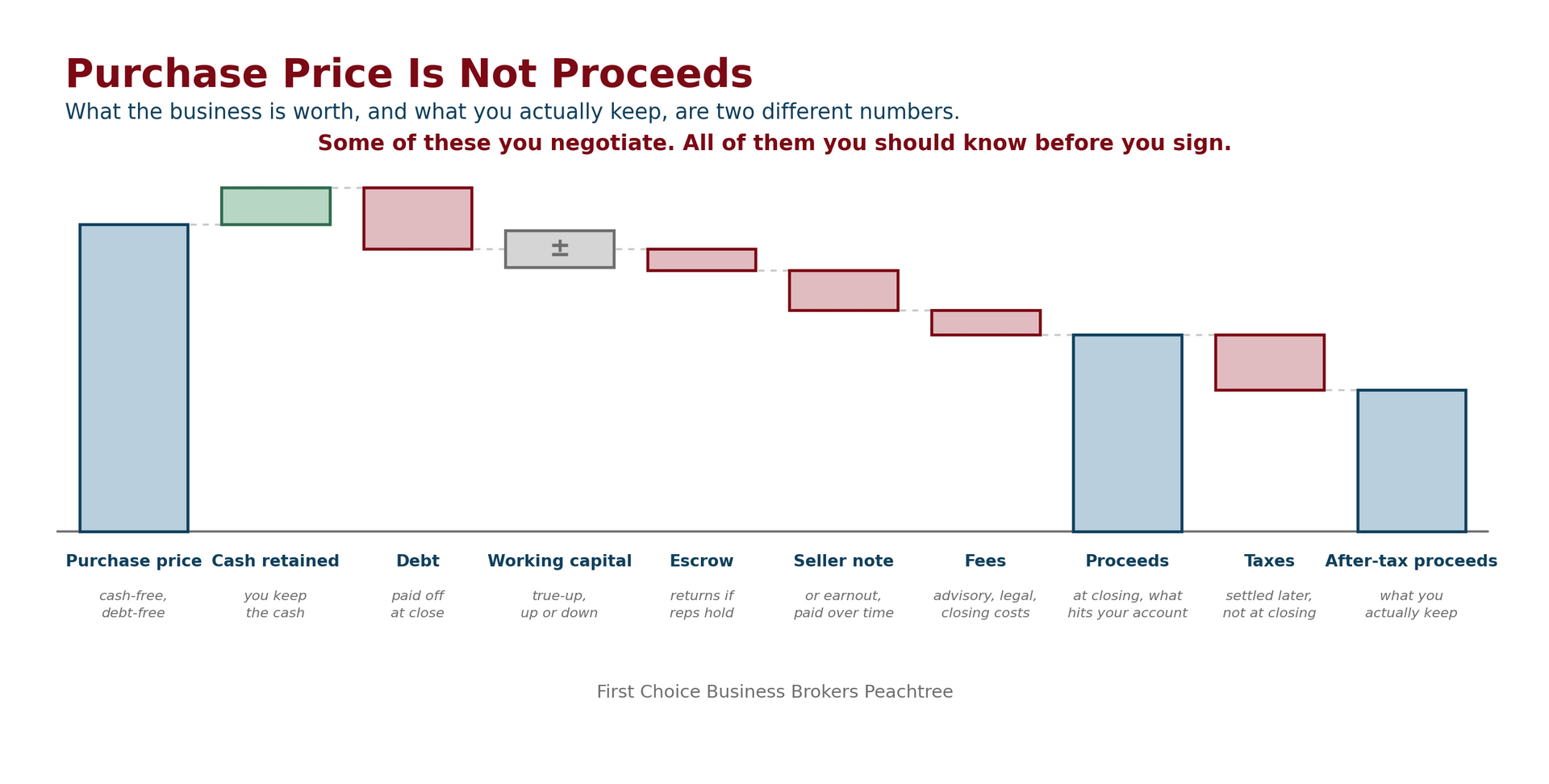
The purchase price answers what the business is worth. It does not answer what reaches you, and that gap surprises owners more than any other part of a sale. The difference is not a fee taken off the top at the end. It is built into how the price is defined and how it is paid.
Start with what the price does and does not include. In most transactions above the smallest end of the market, the price is quoted on a cash-free, debt-free basis, delivered with a normal level of working capital.
In plain terms: you keep the cash in the business, you pay off the debt at closing out of the proceeds, and you leave enough working capital behind for the business to keep running the day after. How that level gets set is its own negotiation, and getting it wrong costs real money at the wire.
Structure is where the rest of the gap lives. How the price is paid matters as much as how large it is. Part of it may arrive over time rather than at closing, through a seller note or an earnout, which makes it a claim rather than cash.
A portion may sit in escrow against the representations you made. Transaction fees come out at closing. Taxes do not. You receive the proceeds and settle with the taxing authorities on their own timeline, and how the transaction is structured changes what is owed, which is a conversation for your accountant and your attorney, and one worth having early.
None of that reduces what the business is worth. It changes the proceeds at closing.
Price is the conversation. Proceeds are the outcome, and the work that separates them starts long before an offer exists.
A sale process discovers your price. What you built in the years before it decides what there is to find.
None of this is fixed. Every factor a buyer prices is a condition of the business rather than a verdict on it, and conditions can be changed. Most of them move faster than owners expect. How to move them is the subject of the companion piece to this one.
Read next: How to Increase the Value of Your Business
Talk it through before you need it
Most owners ask what their business is worth when they are ready to sell. The more useful time to ask is two or three years earlier, while the answer can still change.
If you want to understand where your business sits against the factors above, and what a buyer is likely to see when they look at it, that is a confidential conversation worth having.
Torey S. Hinkson is President and Owner of First Choice Business Brokers Peachtree, advising business owners across Georgia and the greater Atlanta area. He spent twenty years as an investment banker executing mergers and acquisitions across many industries, representing billions of dollars in transaction value, and now applies that experience to the lower middle market. He served as a Marine Corps infantry officer, holds an MBA from the University of Maryland, and earned a Bachelor of Science from the United States Naval Academy.
Honest valuation. Disciplined process. Confidential execution.