Quality of Earnings: The Analysis That Decides Whether Your Price Survives Diligence
Quick Answer
A Quality of Earnings analysis is an independent accounting study of a company's historical earnings. It verifies whether reported earnings are accurate and identifies how much of the profit is recurring and driven by core operations. Sellers who commission one before going to market bring a validated earnings number to the table, rather than defending an untested one after a buyer's accountants have examined it.
Sellers often think the negotiation ends when they agree on a price. It does not. After the offer is signed, a team of accountants the buyer hired goes through the financial records line by line, verifying what the business reported and testing why the results came out the way they did. What survives that examination determines the number on the closing wire.
That examination is financial due diligence, and every sale has a version of it. How far it goes depends on the buyer and the size of the business. A smaller deal may get a careful review of tax returns and bank statements. Larger deals, and buyers with institutional capital behind them, commission a Quality of Earnings analysis, the formal study that tests what the earnings really are.
The depth varies. The question does not. The part you control is the timing: whether you go to market with an independent, tested set of numbers, or spend diligence defending numbers being examined for the first time.
What is a Quality of Earnings analysis?
A Quality of Earnings analysis, a QoE, is an independent accounting study of a company's historical earnings. It examines whether the reported earnings are accurate, and how much of the profit is recurring and produced by the core operations of the business.
An outside accounting firm works through the financial records and answers four core questions. Are the reported earnings accurate? What is actually driving the financial performance? What working capital has the business required to operate, and how has that requirement trended? And what do the earnings look like once one-time items, owner-specific expenses, and accounting noise are removed?
The deliverable is more than a report. The QoE firm produces its own set of financial statements, along with the schedules that support them: the adjusted EBITDA calculation, the add-back detail, the revenue and margin analysis, a customer concentration schedule, and a working capital analysis.
The difference between a report and a set of financial statements is where the value sits. An owner who commissions a sell-side QoE goes to market with financial statements prepared by an independent accounting firm. Those numbers can carry the marketing materials, and they are built to hold up when a buyer's team examines them. You are not introducing a problem or bracing for a correction. You are presenting accurate financials from the first conversation.
When a buyer works through your internal statements in diligence, the differences from the adjusted figures have already been identified and documented on your side, so you can explain each one as it comes up rather than meet it as a surprise. The variances read as accounting process rather than as overstatement, so the conversation is about how the books are kept, not whether the price was justified.
A QoE is not a valuation. It does not tell you what the business is worth. It establishes or validates the earnings number that every valuation conversation is built on. In a transaction, that number carries the multiple, so every dollar of earnings that holds up under scrutiny is worth a multiple of itself in price.
You decide when your earnings get their first real test
There are two paths.
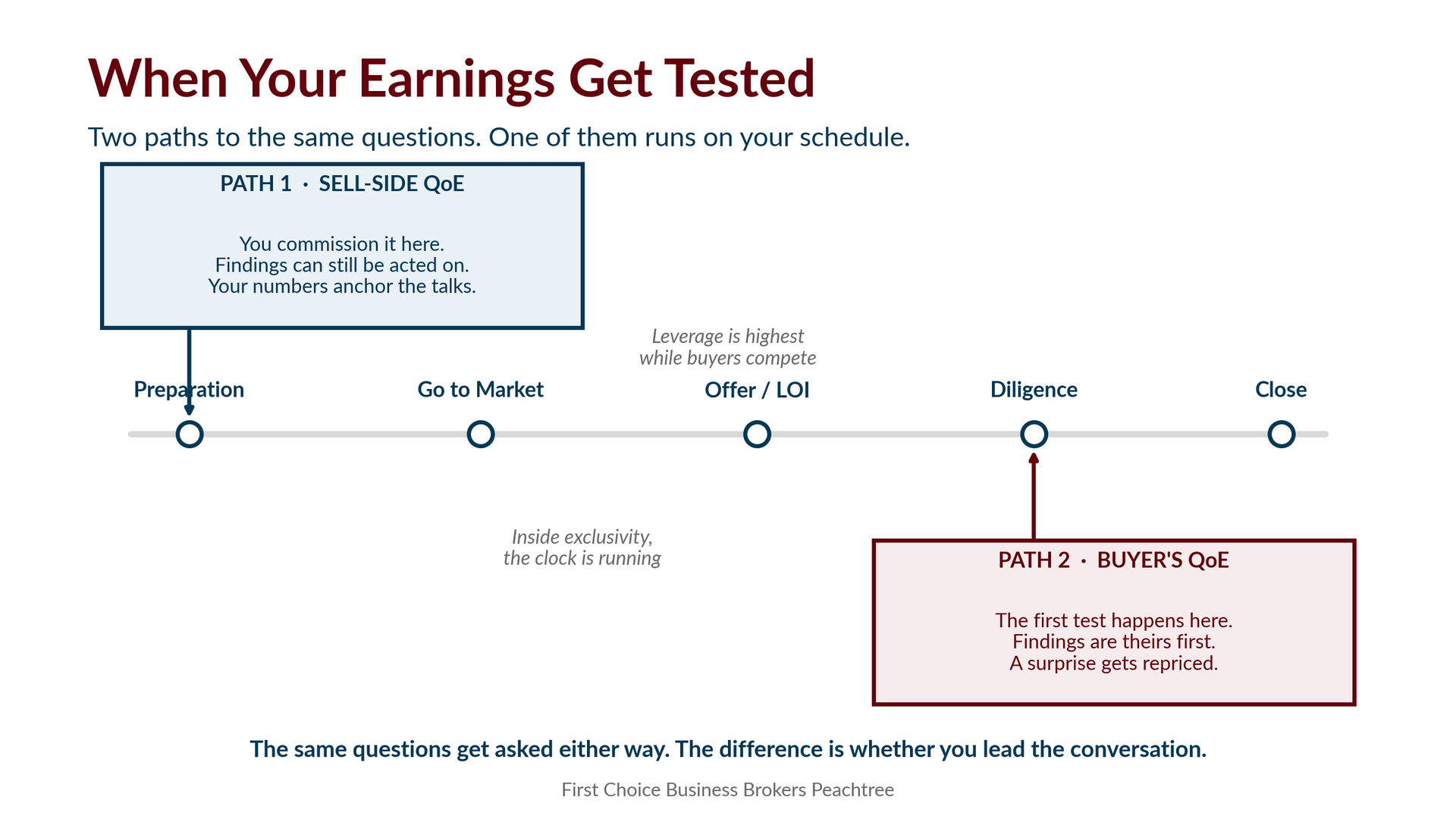
The first path begins in preparation, before the business goes to market. You commission the QoE yourself, and the earnings story starts on your side of the table. Anything worth addressing surfaces while there is still time to fix it, document it, or price it on your terms. It also protects the positioning story: the case you make for the business in the first conversation has to be the case that survives at the end of diligence, and independent analysis behind that story is what keeps the two from drifting apart.
Your adjusted EBITDA figure, your add-back schedule, and your working capital position anchor the negotiation while buyers are still competing, when your leverage is at its highest. It screens buyers as well. One who engages seriously with an independent earnings analysis is underwriting the business. One who sets it aside to hunt for a price reduction is telling you something early, while you still have alternatives.
The second path begins after you have signed. The buyer's accountants examine your earnings for the first time during diligence. The examination happens on the buyer's schedule, and every finding is theirs first. You are inside exclusivity, the clock is running, and you are responding to someone else's read of your numbers. A surprise found there does not get explained. It gets repriced, and a reduction at that stage lands directly on your proceeds.
The same questions get asked either way. The difference is whether you lead the conversation or answer to it.
What does a Quality of Earnings analysis examine?
Whoever runs it, the work concentrates on the places where reported profit and durable profit tend to separate.
- Revenue quality. How revenue is recognized, whether any of it was pulled forward, and how much is contracted or recurring versus re-won every quarter.
- Customer concentration. Where the revenue actually comes from, and what the loss of a single relationship would do to earnings. Underneath that sits a harder question: whether those customers [buy from the business or from you](/insights/articles/do-you-own-a-business-or-are-you-the-business).
- Margin and expense trends. Whether the trajectory the price assumes is visible in the numbers, and whether costs were deferred in a way that flattered a single year.
- Add-backs and working capital. These two move the most money in a negotiation, and each is covered below.
An audit does test revenue recognition, and both audits and reviews apply analytical procedures to margins and trends. They do that work to reach a conclusion about the financial statements as a whole under an accounting framework. None of the three engagements is built to produce an adjusted earnings figure, to assess add-backs for a transaction, or to size the working capital a buyer will expect at closing. That is why those items so often surface for the first time in diligence, when the answers matter most and the time to shape them has passed.
What are add-backs, and how does a QoE validate them?
Add-backs are adjustments that restate earnings to reflect what the business actually produces for an owner. They generally fall into two categories. Non-recurring items happened once and are not expected to repeat, such as one-time legal expenses or an office relocation. Non-operational items may happen every year but are not required to run the business, such as an owner's personal vehicle or above-market compensation.
This is where a QoE earns its keep. Rather than advocating for adjustments, the accounting firm independently assesses and validates each one. Some can get pared back in the process. What survives is a more defensible earnings number, and defensibility is what decides the outcome: a valuation built on validated add-backs is far more likely to withstand a buyer's financial due diligence.
That is the difference between a QoE and a recast. A recast of the financials, normalized for add-backs, is standard preparation and belongs in every process, but it is the company's own number, prepared by the party with an interest in the result. A QoE is the independent accountant's number. Buyers treat the two differently, and the difference shows up in how hard they push.
Working capital: put your number on the table first
A QoE also produces a [working capital analysis](/insights/articles/how-working-capital-actually-gets-set-in-a-business-sale): what the business actually requires to operate through a full cycle, including its seasonality and trend.
This becomes a negotiation. Buyer and seller agree on the working capital the business needs, and the seller delivers that amount at closing. A sell-side QoE front-loads that negotiation. It will not finalize the number, but it puts your analysis on the table early, which makes it a discussion between informed parties. Leave it open, and it gets decided late, when the leverage has moved.
What changes when the buyer's accountants arrive?
The buyer's team still runs its own analysis. That does not change, and it should not. Their firm's independent conclusion is what their client is paying for, so they will build their work largely from scratch regardless of what you have already produced.
What changes is your position while they do it. The records they ask for are already assembled. The questions they raise have documented answers behind them. And you have your own accounting firm that can speak to their work directly, in their language, rather than leaving you to field technical questions alone.
The difference shows up most when the two analyses disagree. Without a sell-side QoE, a buyer's finding lands on you, and you are defending your own bookkeeping against a professional firm. With one, the conversation happens between two accounting firms working from the same source material. That is a technical discussion between professionals, not a renegotiation of your price.
Do I need a QoE if I already have compiled, reviewed, or audited financials?
Start with what those statements are built to do. Most lower middle market companies work from compiled or reviewed statements, and for many owners that is the right standard for running the business. A compilation presents management's numbers in proper form. A review adds limited assurance. An audit goes furthest, testing whether the statements fairly present results under accounting standards, and it sets a high bar for that verification.
All three are built to confirm the numbers are presented correctly. Think of them as certifying the scoreboard.
A QoE studies the game tape. It takes the same historical results and digs into the drivers behind them. It confirms accuracy as well, to a standard below an audit, because it is a different tool built for a different purpose. And like an audit, a QoE examines history. It does not evaluate your projections.
The practical answer comes down to two gaps. None of the three engagements sizes the working capital requirement a buyer will hold you to, and none of them assesses add-backs for a transaction. Those two items sit at the center of most price and proceeds negotiations, so strong existing statements do not mean the ground a buyer will press has been covered.
How much that matters depends on your business and on how deeply your current statements already address the trends that drive your results. That is your call to make. It is also worth a conversation with the CPA firm that already prepares your financials. Some firms perform this work themselves. Where they do not, their work papers, their notes, and their familiarity with your business remain valuable inputs, and a QoE provider will move faster with them than without.
Is a quality of earnings analysis worth it for a smaller business?
Yes, but the right depth depends on the deal. Financial due diligence scales with size and complexity, and so should your preparation.
At the smaller end of the market, a buyer and a lender may work primarily from tax returns and financial statements, and the scope of a full sell-side QoE can exceed what the transaction calls for. The Small Business Administration does not require a QoE by name on the acquisition loans it guarantees, though lenders ask for deeper earnings analysis as size and complexity rise. Larger transactions, and those drawing private equity or other institutional buyers, face the most rigorous financial due diligence, and that is where a sell-side QoE most consistently proves its value.
The judgment is not about a revenue threshold. It turns on three things: how complex your earnings story is, how much of your value rests on adjustments a buyer will test, and the quality of the financial statements you already have. An owner working from internally prepared statements carries materially more risk than one with reviewed or audited financials, and past a certain size that gap becomes the largest single obstacle in a process. Knowing your numbers have been tested and will stand up to professional scrutiny is worth something on its own.
When does a Quality of Earnings analysis pay for itself?
A QoE is an engagement with a real fee, scaled to the size and complexity of the business. The better way to weigh it is against what it protects and what it can recover.
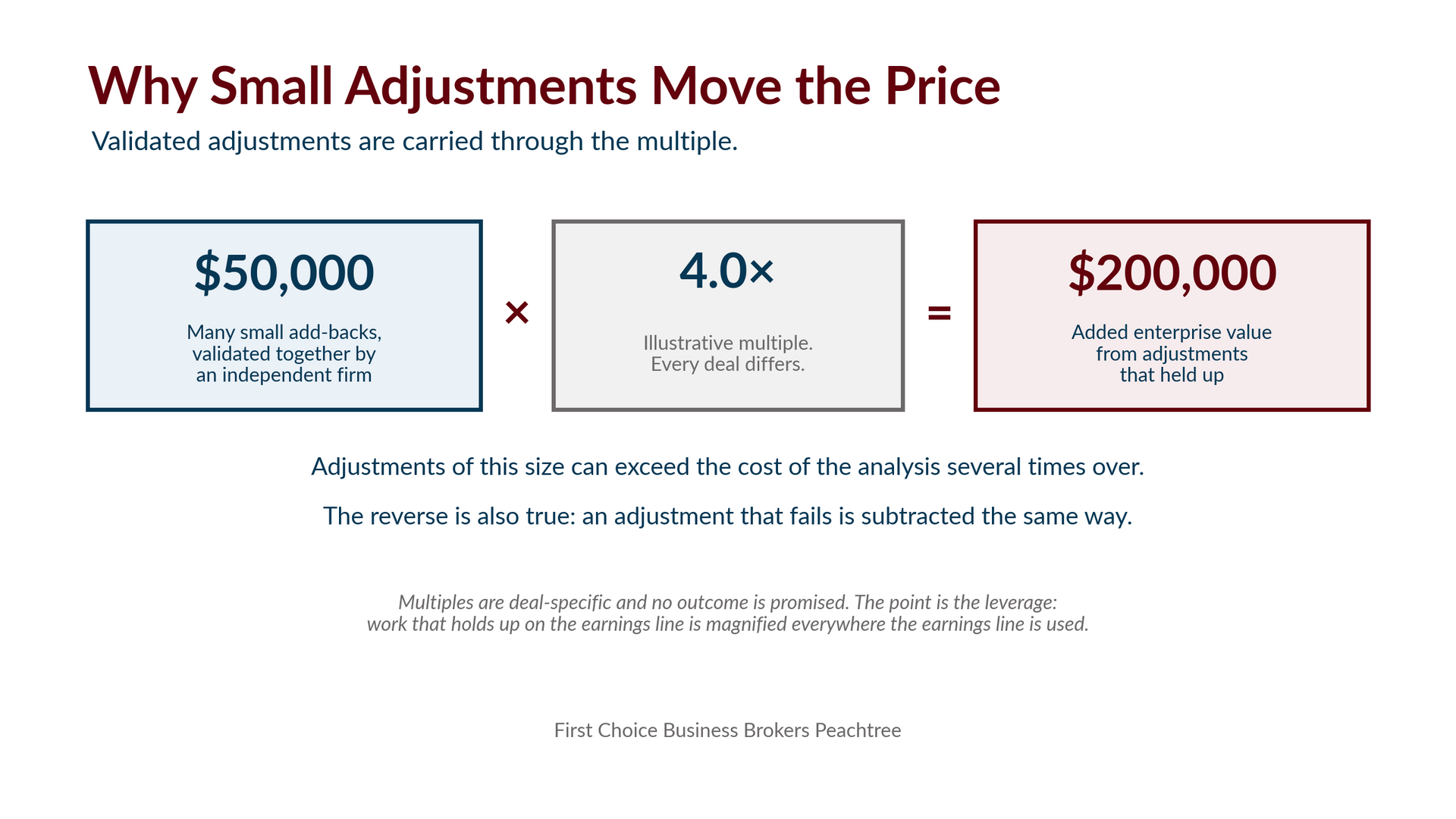
Consider the adjustments as a whole. For most companies this is not one large item. It is $5,000 here and $7,000 there: an owner's vehicle, a family member on the payroll, a one-time legal matter, personal travel run through the business. Individually they look immaterial, and individually they are easy for a buyer to strike. Documented and validated together by an independent firm, they can reach $50,000 or more of adjusted earnings that holds up.
Because value is set by applying a multiple to earnings, the effect on price is several times the adjustments themselves. At a 4.0x multiple, $50,000 of validated adjustments carries $200,000 of enterprise value, which exceeds the cost of the analysis several times over. Multiples are deal-specific and no one can promise yours, but the leverage runs in one direction: work that holds up on the earnings line is magnified everywhere the earnings line is used.
The same logic runs the other way on what you avoid. A working capital position framed early, on your analysis, can move the closing wire. And the price reduction that never happens, because the numbers held, is the quietest savings in the deal.
Timing is straightforward. A QoE belongs in the preparation phase, before the business goes to market, while its findings can still shape the story you lead with. If you already know there are deficiencies in your financial [people, processes, and systems](/insights/articles/do-you-own-a-business-or-are-you-the-business), start earlier. That work takes longer than owners expect, and it cannot be compressed once a buyer is at the table.
Your earnings will be tested. What you decide is whether the first test is your own, while you still hold the leverage.
Talk it through before you need it
A sell-side QoE answers a question that comes before price: whether the business is ready to go to market at all. If the analysis shows earnings that are thinner, more concentrated, or harder to document than expected, that is worth learning while you still have time to act on it, rather than after you have committed to a process and taken the business to buyers.
The owners who get the most out of one are the owners who decide early. If you are weighing a sale in the foreseeable future, the Before You Decide to Sell Your Business, Answer These Three Questions are a good place to start, and a confidential conversation about where your financials stand costs nothing.
Testing your earnings early is also how you keep a priced, agreed deal from falling apart in final due diligence.
What that adjusted earnings figure gets measured against is a separate question, and it comes down to
how a buyer values the business.
Torey S. Hinkson is President and Owner of First Choice Business Brokers Peachtree, advising business owners across Georgia and the greater Atlanta area. He spent twenty years as an investment banker executing mergers and acquisitions across many industries, representing billions of dollars in transaction value, and now applies that experience to the lower middle market. He served as a Marine Corps infantry officer, holds an MBA from the University of Maryland, and earned a Bachelor of Science from the United States Naval Academy.
Honest valuation. Disciplined process. Confidential execution.