How to Increase the Value of Your Business
Quick Answer
Two businesses with the same earnings do not necessarily sell for the same price. The difference is the value a buyer places on those earnings, and that rests on eight conditions inside the business. Those conditions are built by running the business, not by preparing to sell it, and that takes time. Documenting the ones you already meet takes very little, and it is the step most owners skip.
What decides the value beyond your earnings?
The earnings base answers what the business makes. Everything else answers how confident a buyer is that it keeps making it, and grows from there. The eight conditions sit inside three things a buyer can observe: your revenue, your profit, and the people, processes, and systems that run the business. Understanding what they are looking for tells you which work is worth doing.
None of this is a quick fix, and anyone promising one is selling something. The conditions below get built over years of running the business well. They are not arranged in the months before a sale, and a buyer can tell the difference between a business that was built this way and one that was tidied recently.
That is only half the picture, and the other half is where owners leave money. In most businesses, a meaningful part of what a buyer prices is already true and simply not visible to them. Making it visible costs very little and changes what they are able to pay for. Most owners never do it. If it is still undone when you decide to sell, it belongs in the preparation phase, where it becomes the evidence behind your positioning story rather than a scramble on a buyer's timeline.
Earnings set the scale. Confidence decides the difference between two businesses at the same scale, and that is the part owners spend the least time on. The earnings side gets the attention, because it is measurable and the levers are familiar. What a buyer does with those earnings is not something the market hands you. It is a set of judgments about your business specifically, and every one of them has an input.
The eight conditions are doing the work of a forecast, and they do it in two different situations. Where no credible projection exists, a buyer builds one implicitly out of what they can observe. Where a projection does exist, these are the evidence the buyer weighs it against. A forecast is a claim. These are the facts that make the claim believable, or fail to.
One caution before the list. These conditions do not carry equal weight in every business, and anyone who ranks them is offering a tidier answer than the subject allows. Which ones matter most depends on your industry, your size, and who is likely to buy.
Industry does more than shift the weighting. Every sector has its own normal range on each of these, and a buyer reads your business against that range rather than against an ideal. How much of your value your industry sets, and how much sits inside your control, is a subject of its own.
What actually moves the value of your business?
Here is the whole answer before the explanation. Eight conditions, what a buyer finds when they examine each one, and the two kinds of work that move it. Read it as a diagnostic rather than a to-do list. The sections after it explain each one in turn, in the same order. The industry calls these value drivers. That label is close enough to be useful, and it promises more leverage than several of them actually offer.
| Condition | What a buyer finds | Make it provable | Change it |
|---|---|---|---|
| A. Durability of earnings | Contracts, a documented pattern, or neither | Pull the ordering and renewal history on every significant account | Convert relationships to contracts where the business supports it |
| B. Customer concentration | How much rests in one account, and how much in the top ones together | Document the depth of each major account: contacts, sites, products | Win new accounts of comparable size, and grow the smaller ones you have |
| C. Proven growth | The rate, its consistency, and whether it beat or trailed the market | Analyze and record what drove the growth, benchmarked against your market | Grow in ways you can attribute to decisions rather than conditions |
| D. Margin profile and trend | The direction, and whether you can explain it | Document whether the trend reflects investment or erosion | Adjust pricing, mix, or how the work gets done |
| E. Capital expenditure | What the business model requires in facilities, equipment, and assets to run and to grow | Separate maintenance spending from growth spending in your records | Catch up deferred maintenance rather than carrying it into a process |
| F. Working capital intensity | How much cash the business ties up, and to what extent growth intensifies it | Show the trend and what drives the requirement | Collect faster, turn inventory more efficiently, hold terms |
| G. Owner dependency | Whether the relationships and the judgment belong to the company or to you | Name what runs through you, function by function | Move relationships to the company and write the judgment down |
| H. Management quality | Whether anyone other than you owns a real part of the business and delivers on it | Be able to say what each key person owns and what they have delivered | Hire or develop those people, then give them real authority |
Not every condition applies to every business, and no buyer expects it to. A restaurant will not have contracted recurring revenue and is not compared against a business that does. A buyer measures you against others of your type, so each line asks where you sit against that comparison rather than against an ideal.
Two things sit outside the table because a buyer treats them as diligence rather than value. Regulatory and licensing exposure is usually a diligence question, though in licensed trades a lapse or a transfer problem can hold up a closing. Litigation and contingent liabilities behave the same way: they rarely move the price and they routinely move the escrow, the indemnity, and how much of the price is held back. Neither is something you build. Both are conditions you keep clean.
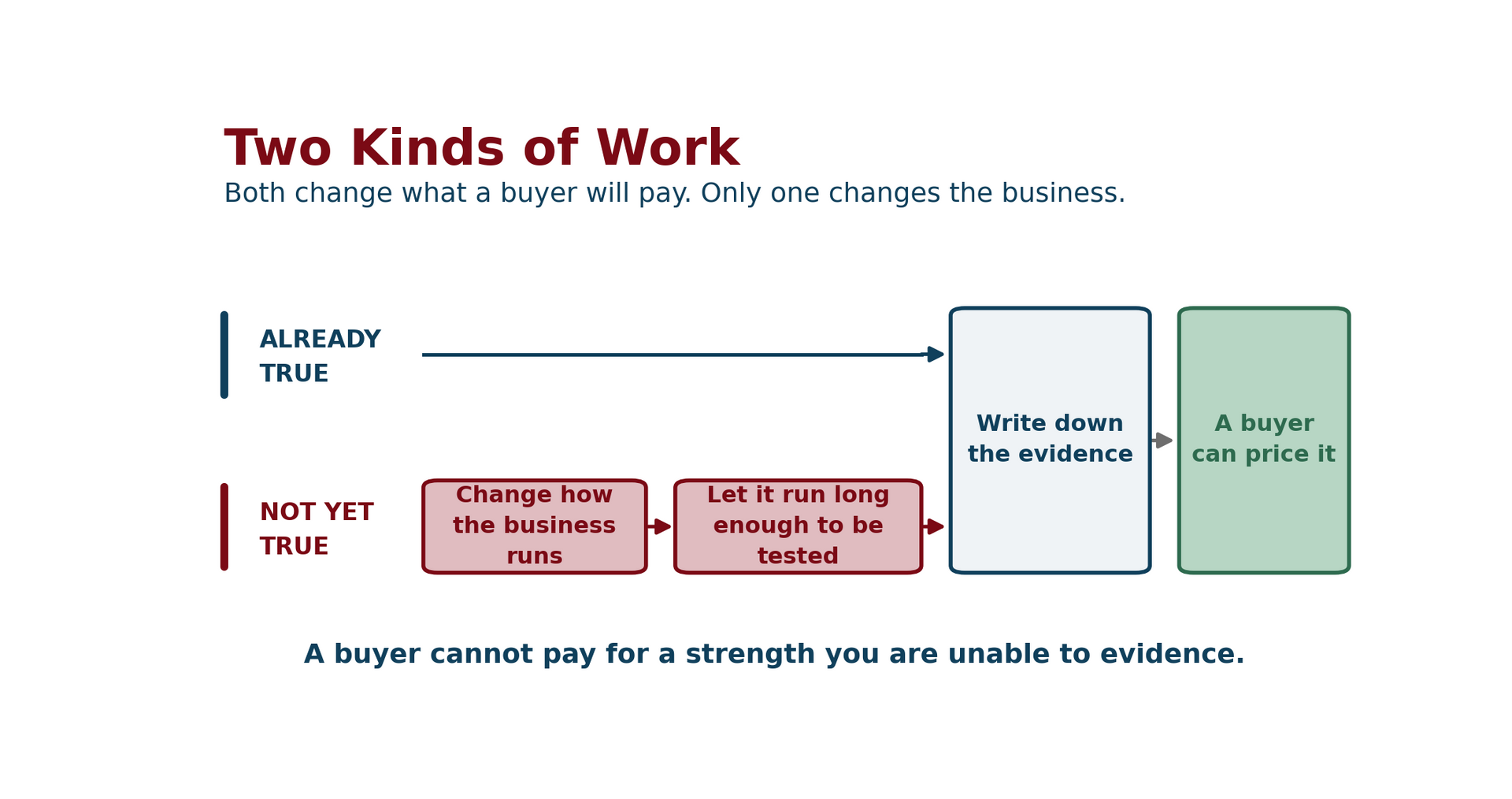
The last two columns are the point, and the difference between them is not effort. It is what each one changes.
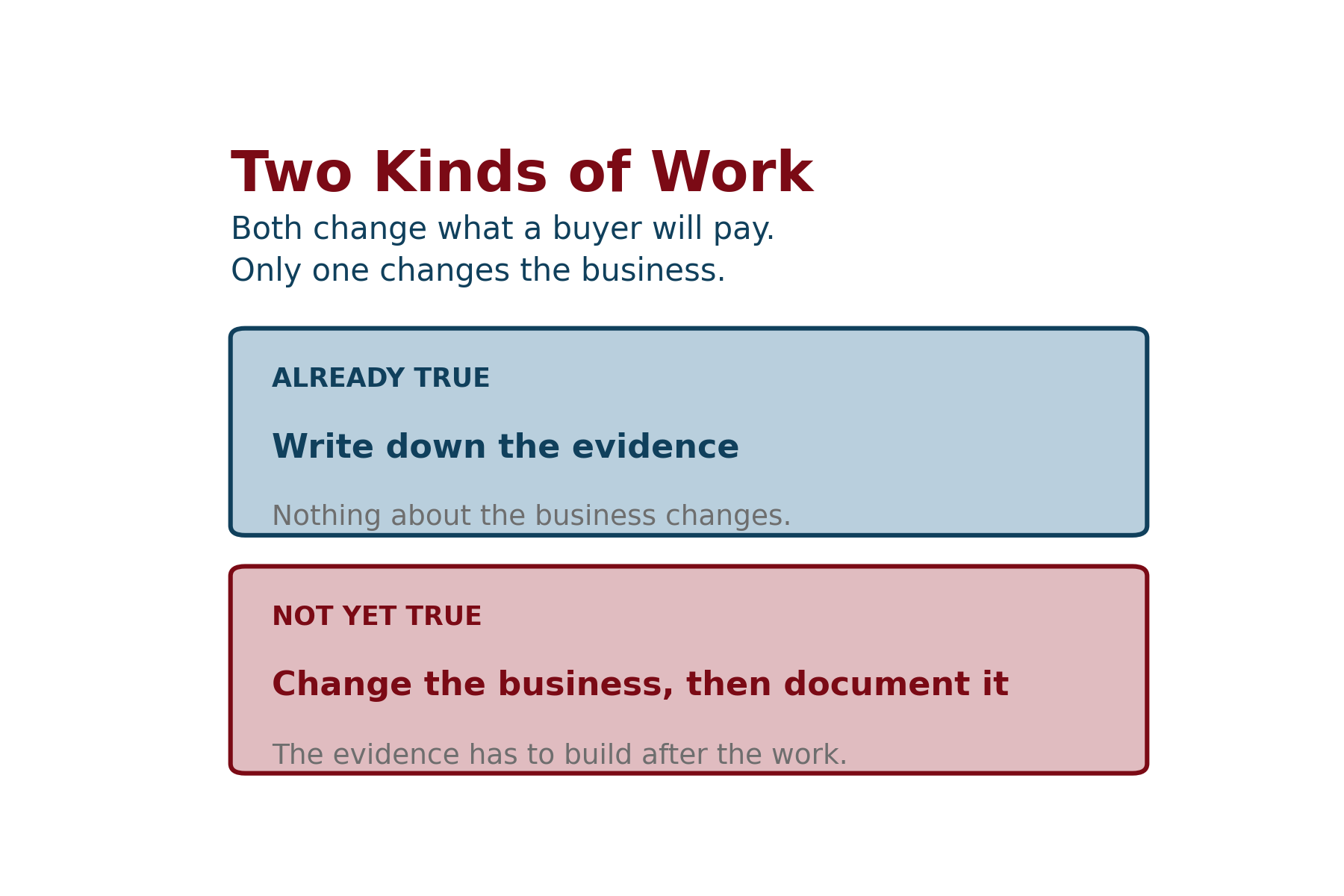
Documentation work does not change the business. It changes what a buyer can verify about it. Operating work changes the business itself, and the verification follows.
Owners systematically undervalue documentation work, because it feels like paperwork rather than progress. A buyer cannot pay for a strength you are unable to evidence. Every year businesses go to market carrying real advantages that never reach the price because nobody wrote them down, and those same advantages, documented, are what a positioning story rests on.
How this reaches an actual number depends on which lens a buyer is working through. In a comparable analysis it is the multiple they apply. In an income analysis it is both the projections they are willing to run and the risk premium built into the rate they discount at. In a financing test it is how much debt they will believe the earnings can carry. Three sets of mechanics, one underlying question, and these eight conditions move all three. The mechanics themselves are explained in how a buyer determines the value of your business.
One assumption sits underneath the whole list. Everything here operates on the historical earnings a buyer accepts, not the earnings you report. Those are rarely the same figure. The difference gets examined in every transaction, and the only real variable is whether the first examination is yours or theirs. That is the subject of its own article here, and it is the work that comes before this work, because every condition above applies to whatever earnings base survives it.
Documentation work is available to you today, in any business, at any point. It needs no runway and no permission from a customer or a market.
Operating work is different. Building a capable team, reducing real concentration, moving margin structurally, and producing a record of growth you can attribute each require something to change and then keep being true.
An owner who begins early can do both kinds of work. An owner who begins when an offer lands has only the documentation work left, and does it on a buyer's timeline instead of their own. Both are better than doing nothing. They are not the same outcome.
How do you strengthen your revenue?
Three conditions live here, and revenue is where the risk to future earnings starts, so a buyer examines each one closely. Durability asks whether the revenue arrives again without being re-won. Concentration asks how much of it rests in one place. Proven growth asks what the business has actually delivered, and why.
A. Durability of earnings
Recurring and contracted revenue prices differently from revenue that has to be re-won every quarter. A buyer is underwriting next year, not last year.
The word recurring gets used loosely, and a buyer means something specific by it. Under contract, with a defined term and a renewal history, is recurring. A customer who has ordered every month for nine years without a contract is not, and that distinction is real.
It is also not the whole picture. Nine years of documented ordering is stronger evidence of durability than a one-year contract signed last quarter by a customer with no history behind it. A buyer weighs the paper and the pattern together, and either one alone leaves a question open. What earns the least credit is revenue described as recurring because it feels reliable to the owner, with neither a contract nor a record to support it.
What moves it.
- To prove it. Pull the ordering history, the renewal history, and the length of every significant customer relationship. Nothing about the business changes, and a buyer sees a materially different risk.
- To change it. Convert relationships to contracts where the business supports it. This is a commercial negotiation and it usually costs something in price or terms.
B. Customer concentration
One customer at a large share of revenue is a risk a buyer may not be able to price, and some cannot accept it at any price. Concentration does not always reduce the number. Sometimes it stops the conversation before a number is discussed.
No single account has to dominate for this to bite. A buyer reads the top account and the top ones together, and a handful of customers making up a very large combined share carries the same exposure even when no individual name stands out. If losing any two of your customers would change how the business operates, that is concentration whatever the largest single number says.
Customer concentration is the version everyone knows. Three others get priced the same way.
- Supplier concentration. A single vendor controls an input, a price, or an allocation you cannot replace quickly.
- Employee concentration. One person holds a certification, a relationship, or a body of knowledge the business cannot operate without.
- End-market concentration. The business is sound as long as one industry or one type of customer keeps spending. This is about what your customers do, not where they are. Serving one metro is normal at this size. Serving one industry is often structural, because the capability that makes you good at it is exactly what those customers are buying. Where that is the case, the work is understanding how that industry's cycle reads to a buyer rather than trying to diversify out of it.
Concentration is the one condition here that can end a process rather than reprice one, which is why it deserves a careful look rather than a quick number. What counts as high varies by industry and by where a business sits in its own arc. A young company that won a large account early reads differently from a mature one whose base has narrowed over time. The useful exercise is measuring your own position against what is normal for businesses like yours, and being ready to explain the difference.
What moves it.
- To prove it. Document the depth of each major account: several contacts, several sites, several products. That shows a buyer the relationship does not rest on one person on either side.
- To change it. Two routes, and owners tend to see only the first. Win and hold new accounts of comparable size, which is ordinary business development rather than sale preparation. Or grow the smaller accounts you already have, which is often faster because the relationship exists and the trust is built. Either one changes the ratio. A large customer resigned early on a longer term also converts an open risk into a contracted one.
C. Proven growth
Growth is performance, not a plan. Once the financials are validated, the record exists and a buyer can read it directly. A forecast alone moves the price very little, because you are asking a buyer to pay today for a result you have not yet produced.
The gap between those is where owners feel most misunderstood, and it is worth understanding rather than resenting. You can see the growth coming. The contract is close, the location is opening, the hire starts in March. A buyer sees the same facts and discounts them heavily, because they are being asked to fund a result they will carry the risk of.
The growth rate is only the opening question. The why behind the numbers is what sets the price. Growth produced by decisions, entering a market, taking share, adding a capability, prices very differently from growth carried along by inflation or by a sector that lifted everyone in it. And growth that trailed the market is a problem even though the line went up, because a business gaining revenue while losing share is telling a buyer something about its competitive position rather than its momentum.
Where the explanation is missing, a buyer supplies their own, and buyers underwrite conservatively.
And the testing does not stop when the financials are handed over. A buyer keeps reading performance from their initial evaluation through closing, which makes results during a live process part of the analysis rather than a backdrop to it. The first test is whether the business is tracking to its own year-end number, adjusted for whatever seasonality the history establishes. As the year progresses, attention shifts forward to the following year, because what a buyer is ultimately underwriting is what the business earns after they own it.
A business that stumbles while under examination gives back more than the shortfall. It gives back the credibility of every other number it produced.
What moves it.
- To prove it. Analyze and record what produced the growth, year by year, and benchmark it against how your market moved over the same period. This is the highest-return documentation work on this list. The growth is already sitting in your financials. The explanation is not, and the explanation decides how much of it a buyer credits.
- To change it. Grow in ways you can attribute to something you did. That sentence is easy to write and it is the hardest item on this list. Every owner is already trying to grow, and most growth is a mix of what you did and what the market did. The distinction a buyer pays for is whether you can point to the decision behind it. Budgeting the year and tracking against it monthly supports the case, though a budget is evidence of management quality rather than evidence of growth.
How do you strengthen your margins and cash flow?
Three conditions here, and the distinction between them matters. Margin asks what the business keeps on each dollar of revenue and which way that is moving. The other two ask how much of that reported profit ever becomes cash, because capital expenditure and working capital sit below the profit line and reduce cash without reducing profit. A business can be profitable and still convert very little of it.
D. Margin profile and trend
Growth and margin are separate questions and a buyer asks them separately. Revenue growth on expanding margins says the business is gaining something: pricing power, scale, operating leverage. The same revenue growth on compressing margins raises a question rather than answering one. Three explanations are common:
- The business is buying its growth, through price or through spending.
- Costs rose and the business could not pass them through. Most businesses do not control their input costs, so this is a question about pricing power rather than about costs.
- The industry itself is changing, through commoditization, a new channel, or a shift in the competitive landscape.
A buyer will want to know which, because those three point to very different futures. The third one often produces the second, since a business loses pricing power when its market changes underneath it.
Where the margin sits against the rest of the sector matters too. A margin well above it invites the question of whether something is being underspent. A margin well below it invites the question of whether it is fixable, and by whom. Neither is automatically a problem. Both are questions a buyer will ask, and the useful thing is to know your own answer.
What moves it.
- To prove it. Document what drove the trend. Margins that compressed while the business invested in capacity for growth read very differently from margins that compressed because the business outgrew its people and systems. What separates those two accounts is the evidence you can produce for either.
- To change it. Pricing, mix, or how the work gets done, all of which customers have to accept. Cost cutting in the year before a sale moves the reported figure and rarely survives examination, because a buyer normalizes back anything that looks like underinvestment.
E. Capital expenditure
Two businesses can report identical profit and keep very different amounts of it. One reason is how much capital the business model itself demands.
This is a question about the kind of business you run, not about how efficiently you run it. Some businesses need facilities, fleets, machinery, or specialized equipment to operate at all, and need more of the same to operate at a larger size. Those businesses carry a continuous obligation to buy, replace, and expand that asset base, which is what makes them capital intensive. A buyer reads the spending and works backward to the model, and profit that has to be recycled into equipment is profit that never reaches an owner.
Businesses sort roughly into three groups on this. Asset-heavy ones carry facilities, fleets, or machinery and the continuous spending that comes with them. Asset-light ones operate on a much smaller base and convert more of their profit into cash. Non-asset businesses, where the value sits in people and relationships rather than in anything on the balance sheet, convert the most.
This is also where deferred maintenance surfaces. An owner who has stopped replacing equipment on schedule has been reporting earnings the business does not actually produce, and a careful buyer normalizes that cost back in.
What moves it.
- To prove it. Separate maintenance spending from growth spending in your own records. Equipment bought to open a second location is an investment in a larger business. Equipment bought to replace what wore out is the cost of staying in the one you have. A buyer expects to see replacement spending at a level that fits your asset base, and a number that looks too low is a problem rather than a strength. It reads as deferred investment rather than efficiency, and it gets normalized back at their estimate rather than your actual cost.
- To change it. Less than owners hope, because the model is the model. Catching up what you have deferred, before a process starts, is the move that is actually available.
F. Working capital intensity
The other reason two identical profits convert differently. Some businesses fund inventory and receivables well ahead of collecting, which leaves less of the profit available as cash. Growth widens that gap rather than closing it, because a larger business funds more inventory and carries more receivables. How much a business needs, and how that level gets set in a transaction, is worth a separate read.
What moves it.
- To prove it. Show the trend and what drives the requirement, so a buyer understands whether the number reflects your terms, your industry, or a collections problem.
- To change it. Working capital intensity responds to management in a way capital expenditure does not. Collect faster, turn inventory more efficiently, hold terms with discipline. That is money you keep every month you own the business, whether or not it is ever sold.
How do you make the business less dependent on you?
Two conditions, and owners routinely assume owner dependency covers both. It does not. Owner dependency asks how much of the business runs through you personally rather than through its people, processes, and systems. Management quality asks how good the people are who carry the parts that do not run through you. A business can score well on one and badly on the other.
G. Owner dependency
If the customer relationships, the pricing judgment, the vendor terms, and the institutional knowledge all live with one person, a buyer is being asked to purchase something that walks out the door at closing. This is the condition owners control most directly and address latest. It is also the one already covered here in full, including the diagnostic a buyer runs and what the work of reducing it looks like, so this piece will point you there rather than repeat it.
What moves it. The method is in that article. The short version is that relationships have to move to the company, judgment has to be written down, and both have to be in place long enough to have been tested before a buyer sees them.
H. Management quality
A business can run without its owner for a few weeks and still have nobody a buyer would trust to run it for a year. That is a separate condition from owner dependency and it gets priced separately.
A buyer is not counting titles. In a smaller business they do not expect a deep bench and will not penalize a flat organization. What they are testing is whether anyone other than the owner owns a meaningful part of the business and delivers on it consistently. One capable general manager changes a buyer's risk more than three mid-level titles.
The evaluation runs on two sides for each person who matters. Whether they have command of their area and deliver against plan, and whether they have built and kept the team around them. Someone who delivers but has built nothing underneath them is a single point of failure.
This shapes the deal rather than only the price. A buyer confident in the people running those parts is willing to let an owner step back soon after closing. A buyer who is not will want the owner tied to the business for longer, and that preference shows up in how much of the price arrives at closing and how much arrives later.
What moves it.
- To prove it. Be able to say what each key person owns and what they have delivered, with something behind it beyond your own assessment.
- To change it. Hire or develop those people, give them real authority, and then leave them alone long enough that the result is evidence rather than an assertion.
A buyer is pricing the future of the business. What they can see is its past.
Know where you stand before it matters
Most owners learn where they stand on these conditions when a buyer tells them. That is the most expensive time to find out, because by then the conditions are set and the only thing still open is the price. The more useful version is a candid assessment two or three years out, while every one of them is something you can still change.
None of this answers whether you are ready to sell, which is a separate question and
worth its own read. But if you want to understand how your business reads against the list above, and which of these you could prove today rather than change, that is a confidential conversation worth having.
Torey S. Hinkson is President and Owner of First Choice Business Brokers Peachtree, advising business owners across Georgia and the greater Atlanta area. He spent twenty years as an investment banker executing mergers and acquisitions across many industries, representing billions of dollars in transaction value, and now applies that experience to the lower middle market. He served as a Marine Corps infantry officer, holds an MBA from the University of Maryland, and earned a Bachelor of Science from the United States Naval Academy.
Honest valuation. Disciplined process. Confidential execution.