

Before You Decide to Sell Your Business, Answer These Three Questions
Before You Decide to Sell Your Business, Answer These Three Questions
Selling a business is one of the most significant financial decisions you will ever make. Here is where to start.
At some point, almost every business owner starts thinking about an exit. The catalyst is different for everyone:
- Maybe years of building something great have you thinking about retirement and what the next chapter looks like.
- Maybe it is a serious conversation with a spouse or a financial planner.
- Maybe it is a passing thought after a hard quarter.
- Maybe someone has already reached out expressing interest in acquiring your business and you are not sure what to make of it.
Whenever that moment arrives, it tends to bring one question to the surface: Is now the right time?
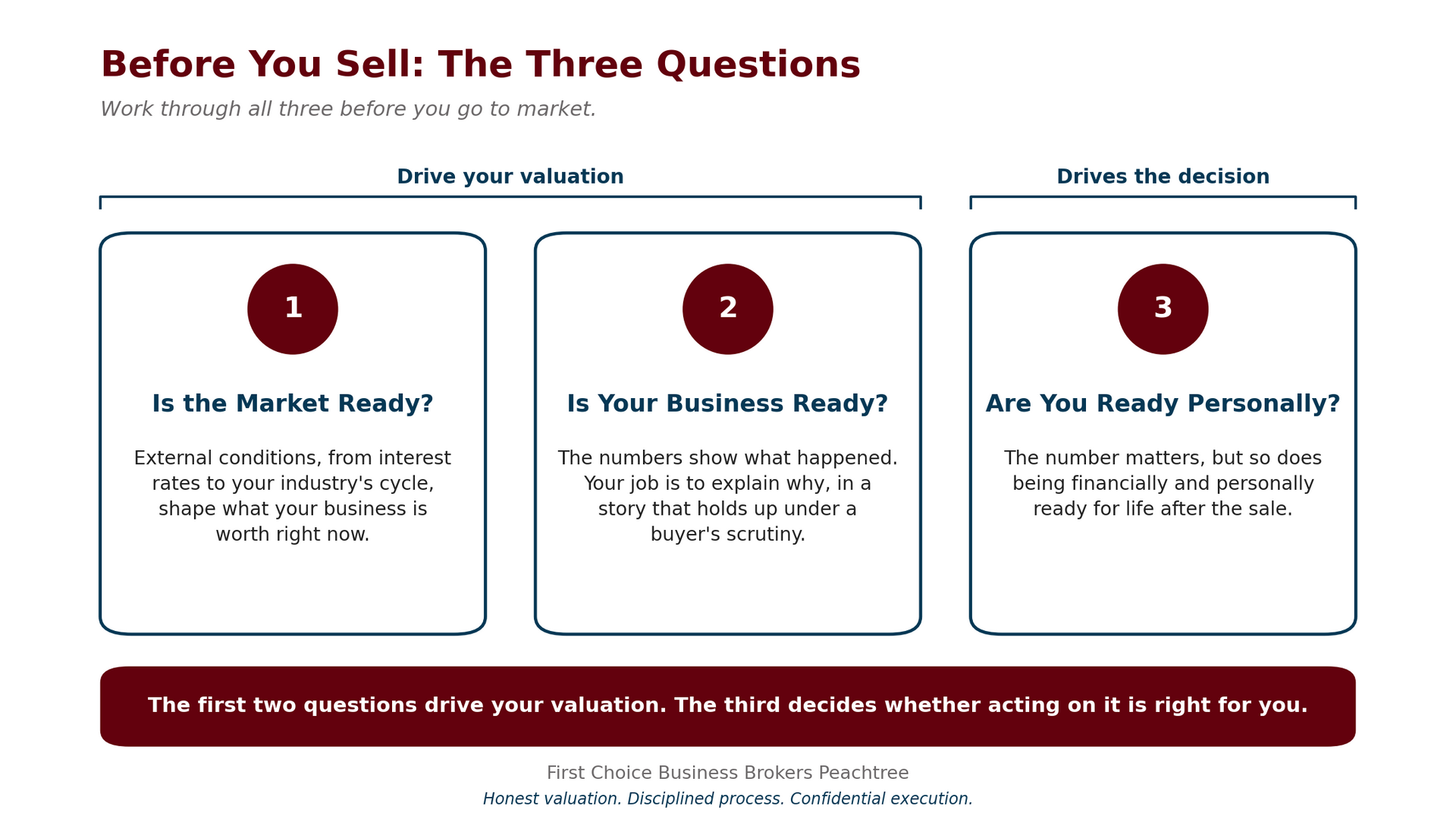
The honest answer requires working through three separate questions, not one. The first two drive your valuation. The third determines whether acting on that valuation is the right decision for you. Owners who work through all three reach that decision with clarity, and when the time is right, they move forward with conviction.
These three questions form the foundation of every conversation I have with a business owner thinking about a sale. They are the product of two decades spent advising entrepreneurs and business owners through transactions that shaped the next chapters of their lives. Work through all three honestly, and you will be better prepared than most.
Question 1: Is the Market Ready?
External conditions shape what your business is worth.
External conditions matter, and they are not just noise. Macroeconomic shifts and cycles, geopolitical conflicts, global health disruptions, shifting trade policy: all of it defines the market backdrop for a potential transaction. These conditions have real valuation consequences. Higher interest rates tighten financing and compress what buyers can pay. You need to understand how the current market environment is shaping conditions for businesses like yours.
These conditions can change quickly, often without warning. The macroeconomic environment that looks one way today can look very different in three or six months. That is why your best strategy is to focus on the things you control. Your advisor should incorporate current market dynamics into your valuation analysis so your valuation reflects today's market realities and can be recalibrated as conditions change. Your energy is best directed toward building the kind of business and sale readiness that lets you move decisively when you decide the time is right.
That starts with asking the right question. Not what the market is doing, but whether the broader environment is showing up in your business. The same macroeconomic shift can be a tailwind in one industry and a headwind in another. Headlines give you context. The signals inside your business, from pipeline and orders to customer and supplier behavior, tell you the truth, often before the financials reflect it.
I saw this play out firsthand when COVID hit in early 2020. I was working with two business owners simultaneously, one in residential services, one in logistics. We had the first business actively in market when the pandemic hit and made the decision to pause the process. Five months later we relaunched, and the business sold quickly at a valuation that exceeded our pre-COVID expectations. Homeowners were investing in their properties, demand had accelerated, and buyers recognized it. The logistics business was a different story. Its end market was hit hard by COVID, and that business did not go to market for nearly two years. When it did, the owner achieved a strong outcome, but the timeline was dramatically extended by forces entirely outside their control. Same advisor, same moment in history, two completely different paths. That is not an anomaly. It is how markets work.
You cannot control the market. You can control how prepared your business is when conditions align. That preparation is what lets you move with confidence when the window opens.
Question 2: Is Your Business Ready?
The numbers tell buyers what happened. Your job is to explain why.
Financial statements and tax returns tell you what happened. They document the numbers. But buyers do not just want to know what happened. They want to know why. Why did revenue grow? Was it because of deliberate decisions you made, or favorable market conditions that may not continue? Why did margins expand or contract? Is it structural, or temporary?
Context matters here. Margins contracting because you are investing in people, processes, and systems to support anticipated growth can reinforce your positioning story. It signals intentional leadership and forward momentum.
On the other hand, margins that look strong on the surface because the business has outgrown its people, processes, and systems will be normalized by a sophisticated buyer in their analysis. The why is not just important. It is what separates a credible seller from a vulnerable one.
The why behind your numbers is the story you will tell from the first conversation with a buyer all the way through due diligence and closing. That story needs to be consistent, credible, and defensible at every stage. A story that holds up early but starts to unravel under buyer scrutiny is not a story. It is a liability.
A buyer's job is to be skeptical. They are going to kick the tires, look under the hood, and ask hard questions. Your job as the seller is to be ready for that, and that readiness is built in advance, with your advisor, not improvised in the middle of a transaction. Tools like a quality of earnings (QoE) analysis exist precisely to help you nail down the why before a buyer asks the questions.
No one understands your business better than you do. What I bring is the outside perspective, the analytical rigor, and the buyer-side experience to pair with that knowledge and get to the most credible version of your story.
All of this should be happening within a disciplined, confidential process, and with the right advisor, it does. A breach at the wrong moment can distract your workforce, unsettle customer and supplier relationships, and surface competitive intelligence you cannot take back. Protecting against that at every stage is a core part of what the right advisor does.
Business readiness also means looking beyond the numbers:
- How owner-dependent is your business?
- Are key customer relationships or critical operational knowledge concentrated in a way that creates risk for a buyer?
- How clean are your books?
These are questions worth addressing before buyers start asking them.
The story you tell on day one needs to be the same story you are telling at closing. That story is built before the process starts, with preparation, the right tools, and the right advisor.
The first two questions prepare you for the transaction. The third one determines how you show up in it, and what you do when it is over.
Question 3: Are You Ready Personally?
The most overlooked question, and the one most likely to surface at the moments when you most need clarity.
This is the question that gets skipped most often, and it is the one most likely to catch an owner off guard, whether in the middle of a transaction or in the quiet that follows one.
Selling a business you have built and run for ten, twenty, or thirty-plus years is a significant life transition. Even a transaction that meets or exceeds every financial target can leave an owner feeling unmoored if they were not fully prepared for what comes next.
This dimension of personal readiness is harder to quantify. Your business has likely been a defining part of how you spend your time, measure your progress, and see yourself professionally. Are you prepared for life without that anchor? Not everyone has fully thought through that question, and that is okay. But it is worth considering before the process starts, because a decision you have not fully made in your own mind has a way of surfacing at the moments when you most need clarity.
The more concrete dimension is financial clarity, and it has two parts that need to be worked through together.
The first is understanding what your business is worth. An honest valuation is not a number you arrive at by instinct. It is a disciplined assessment of your financial performance, your market position, and current deal conditions. That work is what I do.
The second part is understanding what that number means for your life. Your financial advisors, CPA, and/or attorney can help you understand what a transaction produces on an after-tax, after-fees basis and what that means in practical terms. Does it fund the retirement you are planning, or a portion thereof? Does it create the runway for your next venture?
For some owners, the number exceeds what they need and the decision becomes straightforward.
For others, a gap exists between what the business is worth and what they need from a transaction, and that gap needs to be resolved honestly before going to market.
Either way, that reconciliation belongs before the process starts, not in the middle of it. A seller working through that question during active negotiations, with a buyer engaged and under time pressure, is at a significant disadvantage. Do that work first.
The personal and family dimensions of this question sit outside the scope of any deal advisor. That work happens in conversations with the people closest to you, and it is worth having those conversations before the process starts.
Knowing your number does not move the market. But it gives you a clear standard against which every offer, every counteroffer, and every term can be measured.
Why All Three Questions Matter
When the market is ready, the business is prepared, and the seller has the personal clarity to act decisively and navigate the process with confidence, the result is a process that attracts motivated buyers. And motivated buyers, engaged through a disciplined process, are where real negotiating leverage comes from.
These questions hold true regardless of the size of your business or the industry you are in. The numbers and the business model will differ. The principles do not.
The three questions are not independent. They reinforce each other. The owners who get the best outcomes are the ones who worked through all three before the process started.
Every one of these questions looks different when it is applied to your business, your market, and your life. That is the conversation I am here to have. That decision is yours to make. My job is to make sure you make it with full information, honest counsel, and a clear-eyed view of your options.
Honest valuation. Disciplined process. Confidential execution.